Jan 21, 2026 · 12 min read
From Dashboards to Decisions: Why 54% of HR Analytics Projects Fail (And How to Fix Yours)

Saad Sufyan
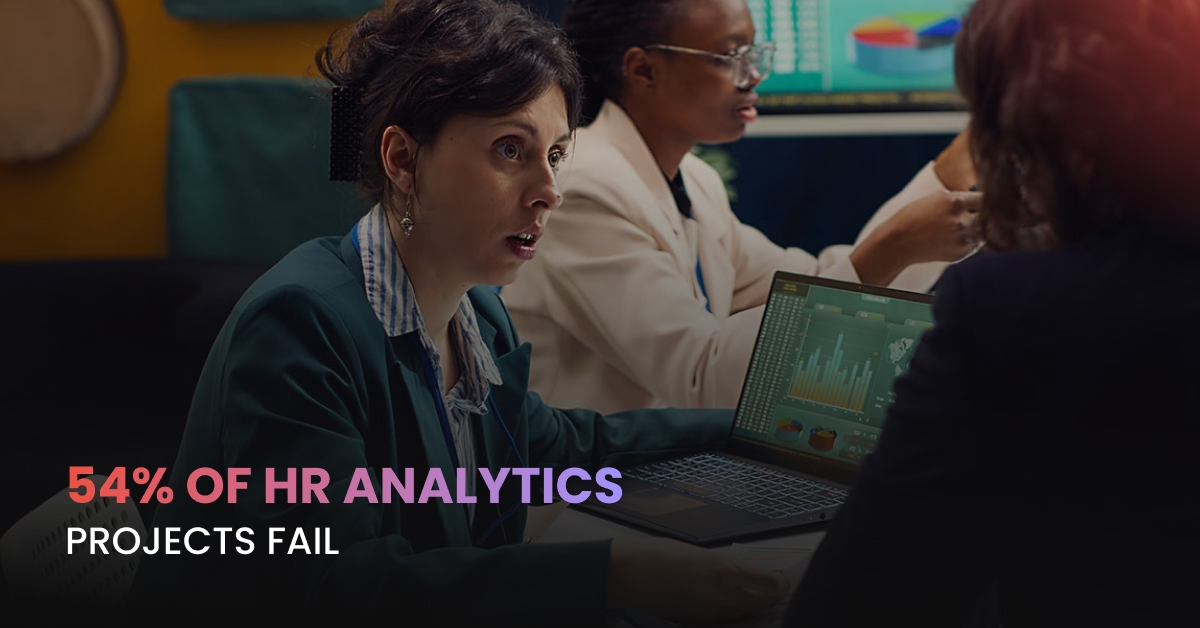
You’ve seen it happen. The executive team gathers for the quarterly review. The CHRO presents a polished dashboard: time-to-fill is down 12%, applicant volume is up 23%, and engagement scores have improved. Everyone nods approvingly.
Then the CFO asks the question that matters: “So why is our revenue per employee dropping?”
Silence.
This is the autopsy problem. Most HR analytics is the equivalent of examining dead bodies, exit interviews, turnover reports, post-hire analyses. It tells you who died and why, but it’s too late to save the patient. You’re conducting expensive autopsies when what you need is a diagnosis, catching the illness before it becomes fatal.
While 71% of companies now prioritize people analytics, only 9% have the capability to predict outcomes. The rest are simply generating prettier charts of things that already happened.
Here’s the uncomfortable truth: having a Tableau dashboard doesn’t mean you have a strategy. It just means you have Tableau.
The real question isn’t whether you’re tracking data. It’s whether that data is telling you what to do next.
What is People Analytics vs. HR Reporting?
Before we go further, let’s establish what we’re actually talking about.
HR Reporting is the operational tracking of metrics. It answers questions like “We hired 10 people this month” or “Our average time-to-fill is 42 days.” It’s backward-looking, descriptive, and primarily useful for compliance and operational management.
People Analytics (or HR Data Analytics) is the strategic application of statistical modeling to talent data to predict business outcomes. It answers questions like “Hiring these 10 people will increase Q3 revenue by 4% due to reduced ramp time” or “This recruiting channel produces candidates with 30% higher retention rates.”
Reporting tells you a hire was made. Analytics tells you the cost-risk if that hire fails. Reporting describes the past. Analytics predicts the future and prescribes action.
The difference isn’t semantic, it’s the difference between earning a seat at the executive table and being relegated to administrative support.
The Data Maturity Ladder: Where Are You?
Most HR leaders know their analytics could be better. The question is: how much better, and what’s standing in the way?
The answer lies in understanding the HR Analytics Maturity Ladder, which consists of four distinct levels. Most organizations remain stuck in the first two stages, relying on historical reporting rather than future-focused strategy.
Level 1: Descriptive Analytics – “What happened?”
This is standard dashboard territory. “Turnover is 15%.” “We made 47 offers last quarter.” “Average tenure is 3.2 years.” These metrics describe the state of affairs but provide no context or insight. You’re looking in the rearview mirror with no understanding of why you ended up here or where you’re headed.
Level 2: Diagnostic Analytics – “Why did it happen?”
Here you begin drilling down into causes. “Turnover is 15% because compensation in Engineering is below market rate.” “Offer acceptance is low because our process takes 6 weeks.” You understand the problem better, but you’re still analyzing the past. You’re performing the autopsy with more precision, but the patient is still dead.
Level 3: Predictive Analytics – “What will happen?”
This is the danger zone where most organizations aspire to be but few reach. “Turnover will increase to 20% in Q3 if we don’t adjust compensation.” “This candidate has an 87% likelihood of accepting based on their profile and market signals.” “We’ll face a talent shortage in data engineering within 8 months based on current attrition and market demand.” You’re finally looking forward, giving leadership time to act rather than react.
Level 4: Prescriptive Analytics – “How can we make it happen?”
This is the promised land. “Use AI-powered sourcing to identify candidates with skills X, Y, and Z now to mitigate the Q3 engineering gap.” “Adjust compensation for these five roles immediately to prevent predicted attrition.” “Prioritize hiring from Channel A, which produces candidates with 2x faster ramp time.” You’re not just predicting the future, you’re telling leadership exactly what to do about it.
Companies with advanced people analytics (Level 3 and 4 capabilities) generate 25% higher profit margins than their peers, according to McKinsey Global Institute. The reason is simple: they make better decisions faster, turning talent into competitive advantage rather than administrative overhead.
Here’s the critical warning that most consultants won’t tell you: don’t try to jump from Level 1 to Level 4 overnight. You cannot predict retention if your basic headcount data is dirty. You cannot prescribe hiring actions if you don’t understand what drove past successes and failures. The ladder exists for a reason, each level builds on the foundation of the one before it.
The “Garbage In” Problem: Why Data Silos Kill Strategy
Here’s the part where we acknowledge the elephant in the room: even if you know what metrics matter, your data is probably a mess.
The primary barrier to effective analytics isn’t a lack of analytical talent or executive buy-in. It’s data siloing, when your ATS, HRIS, performance management system, and compensation platform don’t share a common language or integrate cleanly. Without a unified “intelligence layer,” HR teams spend 80% of their time cleaning data in Excel and only 20% analyzing it.
Sound familiar? “I spend my Mondays copy-pasting CSVs from five different systems, renaming columns, and trying to match employee IDs that don’t align across platforms.” This is Excel hell, and it’s where analytics strategies go to die.
But the problem runs deeper than inefficiency. Data silos create a context gap that makes meaningful analysis impossible. Your ATS knows a candidate was “highly qualified” and “culture fit” based on interview feedback. Your HRIS knows that same person became a “low performer” who left within 18 months. But because these systems don’t talk to each other, you never close the loop. You never learn that “culture fit” was actually code for “similar to the interviewer,” which has no correlation with performance. So you keep hiring the same profile and wondering why turnover stays high.
The traditional response to this problem is to buy enterprise software, integrate everything into one massive HRIS platform, hire a data engineering team, and spend two years on implementation. That’s the $2 million solution.
But here’s what most organizations miss: you don’t need a new ERP. You need an integration layer, a system that sits on top of your existing tools and translates disparate data into unified insights. The goal isn’t to replace everything you have. It’s to make what you have actually talk to each other.
Process friction creates bad data. When scheduling interviews is manual and chaotic, important data points never get captured. When candidate communication happens across email, Slack, and text messages, you lose the conversation history that would reveal why top candidates ghosted you. Clean, strategic data doesn’t come from better dashboards, it comes from better processes that capture signal at the source.
How ConnectDevs Turns Data Into Decision-Ready Intelligence
This brings us to the practical question: how do you actually implement this shift from reporting to prescriptive intelligence?
ConnectDevs was built specifically to solve this problem, to act as the Signal Layer that sits on top of your existing talent stack and transforms raw data into actionable insights.
Here’s how the system creates prescriptive intelligence at each stage of hiring:
The Scout: External Market Intelligence
Most analytics efforts fail because they only analyze internal data. You track what happened inside your company, who you hired, who performed well, who left. But the most important signals are external: What’s happening in the talent market? Which skills are becoming scarce? Which candidates are showing intent signals that suggest they’re open to new opportunities?
The Scout analyzes 800M+ professional profiles to provide the market context your internal data is missing. It doesn’t just find candidates, it identifies supply and demand trends in real-time, helping you answer questions like:
- Should we hire for this role now or wait three months when the market softens?
- Which geographic markets have the best combination of talent supply and cost efficiency?
- Are candidates with this skill set actively looking, or do we need to poach?
This external market data transforms your strategy from reactive (“We have an open role, let’s fill it”) to proactive (“Based on market signals, we should hire these profiles now before demand spikes”).
SAM: Deep Candidate Intelligence at Scale
The biggest data quality problem in recruiting is that traditional interviews generate mostly noise. Notes are unstructured, inconsistent across interviewers, and impossible to analyze systematically. You might have “culture fit” written in 300 feedback forms, but what does that actually mean? How does it correlate with performance?
SAM (our AI interviewing system) solves this by conducting structured, consistent technical interviews that generate high-fidelity, analyzable data on every candidate. But more importantly, SAM captures the “why” behind candidate responses, not just whether they answered correctly, but how they think, how they communicate, and what actually motivates them.
This creates the foundation for quality-of-hire prediction. Instead of waiting 18 months to see if a hire worked out, SAM provides a predictive quality score based on patterns from thousands of previous interviews. Did candidates with this response pattern typically succeed or struggle? How does their technical depth compare to your current high performers?
The result is clean, structured, predictive data captured at the source, not retrofitted later through painful Excel analysis.
The Integration Layer: Connecting Insights to Decisions
Here’s what makes this different from buying another standalone tool: ConnectDevs is designed to feed intelligence into your existing workflow rather than replace it.
The Scout provides market intelligence that informs your hiring strategy and workforce planning. SAM provides candidate assessment data that predicts quality of hire. Both integrate with your ATS, so recruiters see the insights within their existing process rather than logging into another dashboard.
This is the “intelligence layer” approach, enhancing the tools you already use rather than forcing you to rip and replace your entire stack.
The end result is that your analytics stop being backward-looking reports (“Here’s what happened last quarter”) and become forward-looking guidance (“Here’s what to do next quarter to improve quality of hire by 15%”).
From Dashboard to GPS
Think of the difference this way: most HR analytics are a rearview mirror, they show you where you’ve been with great clarity. ConnectDevs is a GPS, it shows you where you are, where you’re going, and provides turn-by-turn directions to reach your destination.
When your executive team asks, “Why is revenue per employee dropping?” you don’t just show them a chart. You show them the predictive model that identified quality-of-hire issues three months ago, the market analysis that explained why top talent is choosing competitors, and the prescriptive action plan for closing the gap.
That’s the conversation that earns you a seat at the table.
Frequently Asked Questions
What’s the difference between HR reporting and people analytics?
HR reporting tracks operational metrics like headcount, time-to-fill, and cost-per-hire. People analytics applies statistical modeling to predict business outcomes, like which candidates will be top performers, when attrition is likely to spike, or which recruiting channels produce the highest quality hires. Reporting describes what happened; analytics predicts what will happen and prescribes what to do about it.
Why do most HR analytics projects fail?
54% of HR analytics projects fail because they focus on backward-looking reporting rather than answering specific business questions. Teams spend resources building dashboards that describe the past instead of models that predict the future. Additionally, data quality issues, siloed systems, inconsistent definitions, manual data entry, undermine even well-designed analytics strategies.
What are the most important HR metrics to track?
The three revenue-linked metrics that matter most are: (1) Quality of Hire (performance ratings + retention beyond one year), (2) Ramp Time (how quickly new hires reach full productivity), and (3) Talent Velocity (whether you’re winning or losing the race for top candidates versus competitors). These metrics directly correlate with business outcomes rather than just measuring process efficiency.
How do I calculate Quality of Hire?
Quality of Hire is typically measured by combining multiple factors: performance ratings at 6 and 12 months, retention beyond the first year, hiring manager satisfaction scores, and time-to-productivity. The formula might look like: Quality of Hire = (Performance Rating + Retention Score + Manager Satisfaction + Ramp Speed) / 4. Advanced approaches use predictive scoring during interviews to estimate quality before the hire is even made.
What is the HR Analytics Maturity Model?
The maturity model consists of four levels: (1) Descriptive Analytics answers “what happened” through basic reporting, (2) Diagnostic Analytics answers “why it happened” by identifying root causes, (3) Predictive Analytics answers “what will happen” using forecasting models, and (4) Prescriptive Analytics answers “what should we do” by recommending specific actions. Most organizations remain stuck at Level 1 or 2.
Can AI really predict which candidates will be successful?
Yes, when properly implemented. AI analyzes patterns across thousands of hiring outcomes to identify which candidate signals correlate with later success, technical assessment scores, structured interview responses, behavioral indicators, and even external market signals. The key is having clean, structured data and validating that your models actually predict performance in your specific context. Predictive accuracy improves over time as the system learns from more outcomes.
How do I get my leadership team to invest in HR analytics?
Speak their language: revenue, productivity, and competitive advantage. Instead of presenting activity metrics (interviews conducted, applicants per role), present business impact metrics (revenue per employee, quality-of-hire trends, predicted attrition cost). Frame analytics not as an HR initiative but as a business intelligence investment that drives better talent decisions, which directly impact the bottom line.
Do I need to hire data scientists to build an analytics function?
Not necessarily. The traditional approach required building custom models from scratch, which did require specialized talent. The modern approach is to use platforms with embedded intelligence, tools that provide decision-ready insights without requiring you to build and maintain statistical models. This “intelligence layer” approach makes advanced analytics accessible without a large data science team.