Jan 23, 2026 · 17 min read
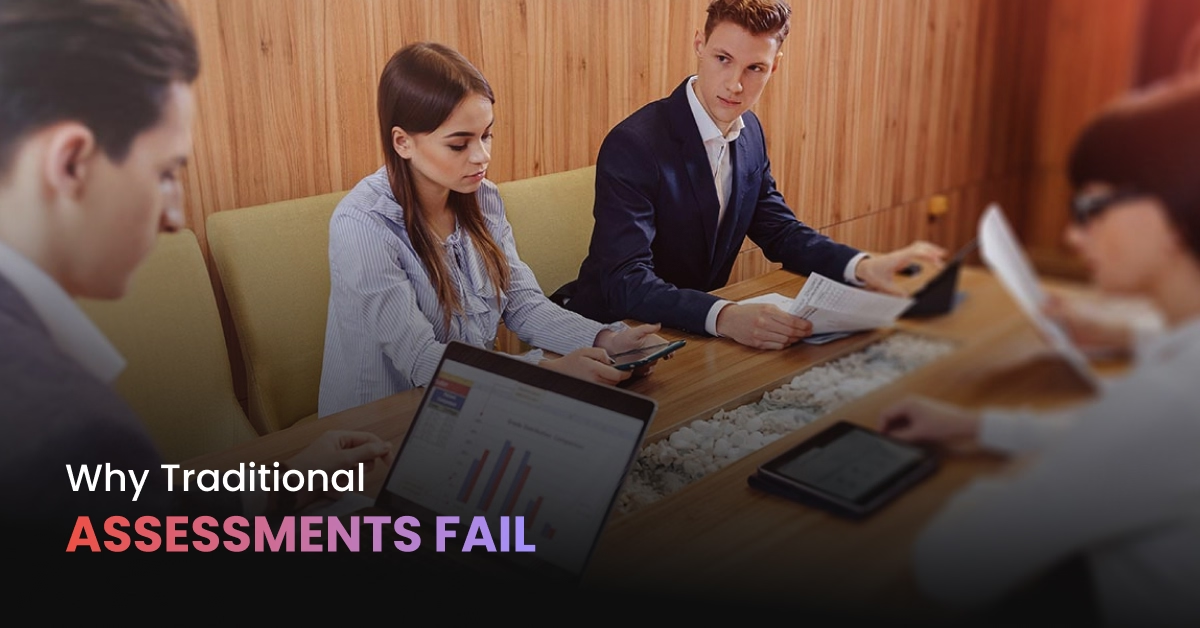
“I’m Not Taking Your Test”: Why Traditional Assessments Are Killing Your Talent Pipeline

Saad Sufyan
Let’s start with a voice from the trenches, a senior software engineer posting on r/recruitinghell:
“I have 10 years of experience. I’m not taking a 45-minute coding test for a job that hasn’t even told me the salary yet. I closed the tab and moved on. They lost a great candidate because they couldn’t respect my time.”
This isn’t an isolated complaint. It’s the sound of your talent pipeline breaking.
Assessment completion rates drop by 15-20% for every 10 minutes of test length. By the time your 60-minute HackerRank assessment is done, your best candidates have already moved to your competitor.
They’re not being difficult. They’re being rational.
In 2019, when unemployment was high and jobs were scarce, candidates took your test because they had to. In 2026, when top talent has five competing offers, they don’t. The power dynamic has flipped, and most companies haven’t noticed.
Here’s the uncomfortable truth: sending a generic assessment link to every applicant isn’t “data-driven hiring.” It’s laziness disguised as rigor. You’re using tests as a filter to block people out instead of as an audition to invite people in.
The question isn’t whether to assess candidates, resumes are provably unreliable, with 70% containing exaggerations or outright fabrications. The question is how to assess them without destroying your candidate experience and hemorrhaging top talent in the process.
What is “Assessment Fatigue”?
Before we go further, let’s define the problem we’re solving.
Assessment Fatigue is the psychological burnout candidates experience when forced to complete multiple, lengthy, and repetitive pre-hire tests during a job search. It’s not about one assessment being too hard, it’s about the cumulative weight of taking 8-10 different company assessments while juggling a current job, family responsibilities, and a personal life.
Assessment fatigue is the primary driver of application abandonment among high-quality, passive talent. Active job seekers (those desperate enough to apply to 50+ jobs) will complete your test. Passive candidates (those who are currently employed and evaluating 2-3 options) will not.
And here’s the kicker: the passive candidates are usually the ones you want. They’re currently performing well somewhere else. They have leverage. They don’t need you, you need them.
This is why top professionals are moving to matching-based platforms that eliminate the assessment gauntlet entirely. They want to be evaluated, yes, but they want the evaluation to respect their time and showcase their abilities, not gatekeep them with generic quizzes.
Why Resumes Are Dead (But Tests Are Dying)
We’re caught between two broken systems.
On one side, we have resumes, the traditional hiring currency that everyone knows is fundamentally unreliable. Research consistently shows that resumes have a predictive validity of just 0.18 for job performance (on a scale where 1.0 is perfect prediction). That’s barely better than flipping a coin.
Why so low? Because 70% of resumes contain exaggerations, 37% include outright lies about credentials or experience, and even honest resumes only capture what someone did, not how well they did it or whether they can do it for you.
Resumes tell you someone has “5 years of Python experience” but don’t tell you if they’re a Python expert or if they copied Stack Overflow code for five years. They tell you someone “led a team” but not whether they were a great leader or a toxic micromanager. The signal-to-noise ratio is abysmal.
So the industry pivoted to assessments, structured tests that actually measure capability. And the data vindicated this shift: well-designed assessments have a predictive validity of 0.71, nearly four times better than resumes. Cognitive ability tests, work sample tests, and structured interviews demonstrably predict job performance.
But here’s where we hit the hard place: while traditional tests have high signal, they also have catastrophically high abandonment rates.
- 60-minute coding assessments: 40-60% abandonment among senior candidates
- Multi-stage assessment processes: 70%+ dropout by stage three
- Generic personality tests: Viewed as insulting by experienced professionals
You gained signal but lost your pipeline. You filtered out the noise, and also filtered out everyone with other options.
The “resume vs. test” debate is a false choice. We don’t need to pick between low-signal-but-easy (resumes) and high-signal-but-punishing (tests). We need a third way: high signal AND high experience.
Just as meeting etiquette has evolved for speed and efficiency in 2026, assessment methodology must evolve for engagement. The companies winning the war for talent aren’t the ones with the hardest tests. They’re the ones with the most respectful evaluation processes.
The Three-Legged Stool: Skills, Behavior, and Cognition
Here’s what most assessment strategies miss: evaluating a candidate requires measuring three distinct dimensions simultaneously. Miss any one of them, and your prediction breaks down.
Leg 1: Cognitive Ability (Can they learn?)
Cognitive ability is the single best predictor of job performance across virtually all roles (validity: 0.65). It measures raw problem-solving capability, pattern recognition, and learning speed. But here’s the critical nuance: you don’t measure this with an IQ test or SAT-style logic puzzles.
You measure it through contextualized problem-solving scenarios. “Here’s a system that’s failing. Walk me through how you’d diagnose the issue.” “Here’s a constraint we haven’t discussed. How does that change your approach?” You’re not testing memorized knowledge, you’re testing whether they can think on their feet when presented with novel situations.
Leg 2: Hard Skills (Can they do the job?)
This is what most assessments focus on exclusively: technical capability. Can they write code? Can they analyze a dataset? Can they design a system architecture?
But even here, most tests fail by testing the wrong things. A multiple-choice quiz on Python syntax doesn’t tell you if someone can architect a scalable microservices platform. A “design this widget” exercise doesn’t tell you if someone understands the tradeoffs between complexity and maintainability.
The key is to test architectural thinking, not syntax checking. Real work isn’t about memorizing API documentation, it’s about making judgment calls under uncertainty.
Leg 3: Behavioral Fit (Will they work well here?)
This is the dimension most assessments completely ignore, and it’s why organizations using valid assessments still see 39% lower turnover among high-scoring candidates rather than eliminating turnover entirely (Aberdeen Group). Technical skill gets someone hired; behavioral mismatch gets them fired.
But you can’t measure behavioral fit by asking “Are you a team player?” or “Do you work well under pressure?” Everyone says yes. You measure it by observing how they react to ambiguity, frustration, or pushback during the evaluation itself.
Do they get defensive when challenged on their approach? Do they show curiosity when presented with a constraint they hadn’t considered? Do they communicate clearly when explaining complex topics? These behavioral signals leak through during any substantive conversation, if you’re capturing them.
The breakthrough insight: you don’t need three separate assessments to measure these three dimensions. You need one well-designed simulation that captures all three simultaneously through natural interaction.
This is exactly what AI-powered interview platforms enable. By analyzing natural language during a technical conversation, systems can simultaneously evaluate problem-solving ability (cognition), technical depth (hard skills), and communication patterns (behavior). The candidate has one experience; you get three-dimensional signal.
And critically, this signal powers the next generation of intent-based matching systems that go beyond keyword searching to actually understand capability and fit.
The Problem With “Tests”: Why Filtering Out Feels Like Disrespect
Let’s be honest about what’s really happening when you send a generic assessment link to every applicant.
You’re not saying, “We want to understand your capabilities.” You’re saying, “We don’t trust you, and we don’t value your time enough to have a conversation before demanding proof.”
The assessment-as-filter approach treats candidates like inputs on a factory line. Send 1,000 links. Get 400 completions. Advance 50. It’s efficient for you, but it’s dehumanizing for them.
And here’s what the data reveals: the candidates most likely to abandon your assessment are the candidates you want most.
Passive candidates with strong current jobs abandon at 2-3x the rate of desperate active job seekers. Senior candidates abandon at higher rates than junior candidates. Candidates with competing offers abandon at higher rates than those with no other options.
Your filter is backwards. It’s keeping out the people with choices and letting in the people with none.
This is the “assessment paradox”: the more you need signal to differentiate top talent, the less willing top talent is to provide it through traditional testing mechanisms.
The root cause isn’t that candidates are lazy or entitled. It’s that traditional assessments violate basic principles of fair exchange:
- Principle 1: Reciprocity You’re asking for 60 minutes of their time before you’ve invested 10 minutes in a conversation. You want proof of their skills before you’ve proven the opportunity is real. This violates social norms of reciprocal investment.
- Principle 2: Respect Sending a generic link says, “You’re interchangeable.” It doesn’t acknowledge their specific experience or context. A senior engineer with 10 years of Kubernetes experience shouldn’t take the same assessment as a recent bootcamp grad, but most companies send the exact same link to both.
- Principle 3: Value Exchange Traditional tests extract value (data about the candidate) without giving value back (feedback, learning, meaningful conversation). The candidate invests an hour and receives… nothing. Maybe a rejection email three weeks later.
When you violate these principles, top candidates opt out. They don’t opt out because they lack skills. They opt out because they have self-respect and other options.
The fix isn’t to eliminate assessment. The fix is to transform assessment from a filter into an audition, an experience that’s valuable for both parties, even if the ultimate answer is “not a fit.”
The “Un-Test”: How AI Interviews Turn Assessment Into Engagement
This is where we need to fundamentally rethink what an assessment can be.
Imagine instead of sending a candidate a HackerRank link, you said: “We’d like you to have a 25-minute technical conversation with our AI interviewer, SAM. SAM will ask you about your experience, walk through a realistic scenario, and give you immediate feedback on your approach. It happens on your schedule, start it at 11 PM if that works better. And you’ll learn something about our technical expectations even if we ultimately don’t move forward.”
That’s a different proposition. It’s not a filter, it’s an audition. And it fundamentally changes the psychology of the interaction.
This is exactly what ConnectDevs SAM (our AI interviewing platform) was designed to do: create the “un-test” that provides all the signal of a rigorous assessment with none of the candidate experience penalties.
The “Audition” Feel: Assessment as Conversation
SAM doesn’t present multiple-choice questions or demand that you write code in a browser window. It has a conversation with you, the way a senior engineer or hiring manager would during a first-round technical screen.
“Tell me about the most complex system you’ve designed. What were the main architectural challenges?”
“Interesting. How would you modify that design if I told you we need to support 100x the traffic?”
“You mentioned using microservices. When would you choose a monolith instead?”
This conversational format accomplishes something critical: it feels respectful. The candidate isn’t jumping through arbitrary hoops, they’re demonstrating their thinking to someone (or something) that understands the domain and asks thoughtful follow-up questions.
The psychological difference is enormous. One feels like a test you can pass or fail. The other feels like a technical discussion you’d have with a colleague. Same rigor, different experience.
Deep Signal: What AI Can See That Tests Can’t
Here’s where AI-powered interviews become genuinely superior to traditional assessments.
A multiple-choice test captures one bit of information: right or wrong. A coding challenge captures a code sample. Both are useful but limited.
A conversational AI interview captures 100+ distinct signals simultaneously:
- Technical depth: Do they understand the fundamentals, or are they parroting terminology?
- Communication clarity: Can they explain complex concepts simply?
- Confidence calibration: Are they appropriately confident (good) or overconfident (dangerous)?
- Response structure: Do they think methodically or jump to conclusions?
- Adaptability: When challenged with a constraint, do they revise their thinking or defend a flawed approach?
- Curiosity: Do they ask clarifying questions, or make assumptions?
SAM analyzes tone, pacing, vocabulary choice, logical structure, and domain knowledge, not just “what” someone says but “how” they say it. This is the three-legged stool we discussed earlier: cognitive ability (how they problem-solve), hard skills (technical accuracy), and behavioral fit (communication and collaboration signals).
And critically, SAM can detect patterns that human interviewers miss. For example, candidates who use passive voice when discussing past challenges (“mistakes were made”) versus active ownership (“I made a mistake in the caching layer”) show significantly different accountability profiles. Humans rarely notice this linguistic pattern. AI catches it every time.
This deep signal feeds into the complete recruiting cycle, where sourcing (Scout), engagement (Pilot), and evaluation (SAM) work as an integrated system rather than disconnected stages.
The Efficiency Advantage: 24/7 Assessment Without Calendar Tetris
Traditional interviews require calendar coordination, the endless back-and-forth to find a time when candidate and interviewer are both available. This adds days or weeks to your hiring timeline and creates dropout points.
SAM is available 24/7. The candidate in Tokyo interviewing for your San Francisco role can complete their assessment at 10 PM local time without waiting for your business hours. The working parent can do it after the kids are asleep. The currently-employed passive candidate can do it without taking PTO or sneaking away during lunch.
This isn’t just convenient, it’s strategic. Speed kills in competitive talent markets. The company that can evaluate a candidate within 24 hours of application has a massive advantage over the company that needs two weeks to schedule a phone screen.
And from the candidate’s perspective, immediate feedback is gold. Instead of completing an assessment and waiting in limbo for a week, SAM provides instant evaluation: “Strong performance on system design, could strengthen algorithm optimization approach, advanced to next round.”
This respects the candidate’s time and reduces anxiety, both of which improve your employer brand and increase offer acceptance rates down the line.
Respectful Evaluation: Getting Signal Without the Dropout
Here’s what makes this approach fundamentally different from traditional assessments:
It gives as much as it takes. The candidate invests 25 minutes and receives immediate, specific feedback on their technical approach. Even if they don’t advance, they learned something. That’s a fair exchange.
It adapts to experience level. SAM doesn’t ask a senior architect the same questions as a junior developer. It tailors the conversation to the candidate’s background, making everyone feel respected rather than processed.
It happens in the flow. Instead of “apply, then get a test link 3 days later,” the assessment is integrated into the initial application. The candidate knows what they’re signing up for and can complete it while they’re already engaged.
The result: completion rates for SAM interviews are 2-3x higher than traditional assessment completion rates, while providing dramatically richer signal than multiple-choice tests or resume reviews.
You’re not filtering people out with hoops. You’re inviting them to showcase their abilities through a meaningful conversation.
From Filter to Audition: Rethinking Assessment Philosophy
The fundamental shift required here isn’t technical, it’s philosophical.
Old mindset: Assessments exist to filter out bad candidates as cheaply as possible.
New mindset: Assessments exist to identify great candidates while respecting everyone’s time and building employer brand.
When you operate from the filter mindset, you optimize for elimination. Cheap, fast tests that reject 90% of applicants. Success is measured by how few people you have to interview.
When you operate from the audition mindset, you optimize for discovery. Engaging evaluations that reveal capability while treating candidates as professionals. Success is measured by how many great hires you make and how many rejected candidates still recommend you.
The companies winning the war for talent have made this philosophical shift. They understand that in a market where top candidates have options, candidate experience isn’t “nice to have”, it’s a competitive weapon.
Consider this: when a candidate has a great assessment experience, even if they don’t get the job, 60% will apply again in the future, and 40% will actively refer other talented people to your company. When they have a terrible experience, 70% will never apply again, and 30% will actively discourage others from applying.
Your assessment isn’t just evaluating candidates. It’s being evaluated by candidates. And they’re sharing that evaluation on Glassdoor, Blind, Reddit, and in their professional networks.
This is why the “un-test” approach matters so much. You’re not just getting better signal (though you are). You’re building a reputation as a company that respects talent, which compounds over time into a competitive advantage in attracting the best people.
Key Takeaways: Stop Testing, Start Auditioning
The assessment crisis in modern recruiting isn’t about whether to evaluate candidates, it’s about how to do it without destroying your talent pipeline and employer brand.
Here’s what to remember:
Traditional assessments are optimized for the wrong metric. They minimize your effort (send a link, let automation filter) while maximizing candidate dropout. You keep the desperate candidates and lose the ones with choices, exactly backwards from what you want.
Assessment fatigue is real and getting worse. Top candidates are applying to 2-3 companies, not 50. They won’t complete 8 different company assessments. Your assessment needs to be the one they choose to complete, which means it must offer something in return for their time.
You need three-dimensional signal. Cognitive ability (can they learn?), hard skills (can they do the job?), and behavioral fit (will they work well here?) must all be evaluated. Most tests only measure one. AI-powered conversations can measure all three simultaneously.
The “filter vs. audition” mindset matters more than the specific tool. Filters eliminate. Auditions discover. Filters extract value. Auditions exchange value. When you shift from filter to audition, your entire assessment strategy transforms, regardless of which specific platform you use.
Conversational AI solves the paradox. You get high signal (better than traditional tests) with high completion rates (better than traditional tests). The candidate feels respected and evaluated rather than tested and judged. This wasn’t possible five years ago. It’s standard practice now for companies that want to compete for top talent.
Speed compounds with quality. 24/7 AI interviews mean you can evaluate a candidate within hours of application rather than weeks. In competitive talent markets, this speed advantage often determines who gets the yes before other offers arrive.
The bottom line: if you want better hires, stop treating candidates like schoolchildren taking a quiz. Invite them to audition. Show them what working with your team would feel like. Get the signal you need without the dropout you can’t afford.
The companies that make this shift aren’t just hiring faster, they’re hiring better while building a reputation that attracts even more top talent in the future.
Ready to transform assessment from a filter into an audition? See how SAM turns evaluation into engagement while providing deeper signal than traditional tests.Explore the platform →
Frequently Asked Questions
Why do candidates abandon pre-hire assessments?
Candidates abandon assessments for several reasons: the assessment is too long (dropout increases 15-20% per 10 minutes), they feel disrespected by generic tests that don’t acknowledge their experience level, they have other opportunities that don’t require assessments, or they perceive the effort-to-reward ratio as unfair. Passive candidates with strong current jobs are 2-3x more likely to abandon than desperate active job seekers.
Are resumes really that unreliable for predicting job performance?
Yes. Research consistently shows resumes have a predictive validity of just 0.18 for job performance (where 1.0 is perfect prediction). This is because 70% of resumes contain exaggerations, 37% include outright lies about credentials, and even honest resumes only describe past activities, not capability or cultural fit. Well-designed assessments have 4x better predictive validity at 0.71.
What’s the difference between hard skills and soft skills assessment?
Hard skills assessment evaluates technical capability, can they write code, analyze data, or design systems. Soft skills (or behavioral) assessment evaluates how they work, communication style, problem-solving approach, collaboration ability, and cultural fit. Most traditional tests only measure hard skills, which is why companies hire for skill but fire for behavioral mismatch. Complete assessment requires measuring both.
How long should a pre-hire assessment be?
Research shows optimal length is 20-30 minutes. Every 10 minutes beyond this increases abandonment by 15-20%, with senior candidates and passive job seekers dropping out fastest. However, length matters less than engagement, a 25-minute conversational interview feels shorter than a 15-minute multiple-choice quiz because one is engaging while the other is tedious.